










Most people treat AI like a vending machine. You punch in a request, something comes out, and if it’s bad, you shrug and try again. That’s not how it works, and once you understand prompt engineering, you’ll never go back to random guessing.
Prompt engineering is the skill of communicating with AI models in a way that consistently gets you useful, accurate, and high-quality results. It sounds simple. It’s not, but it’s also not as complicated as the name makes it sound.
In this guide, I’ll break down exactly what prompt engineering is, why it matters in 2026, and how you can start using it right away, even if you’ve never written a structured AI prompt before.
📋 TL;DR
- Prompt engineering = crafting AI inputs to get better outputs
- It’s a practical skill, not just a technical one
- The basics: be specific, give context, define format, iterate
- Even simple prompt improvements can dramatically change output quality
- You don’t need to be a developer to do this well
What Is Prompt Engineering, Actually?
A prompt is anything you type into an AI model. Prompt engineering is the practice of designing those inputs intentionally — choosing the right words, structure, context, and instructions to guide the AI towards a specific, useful output.
Think of it like giving directions. “Get me to the airport” is a prompt. “Take the M1 motorway, exit at Junction 6, and drop me at Terminal 2 departures” is a prompt-engineered request. Both are asking for the same thing. One gets you there reliably.
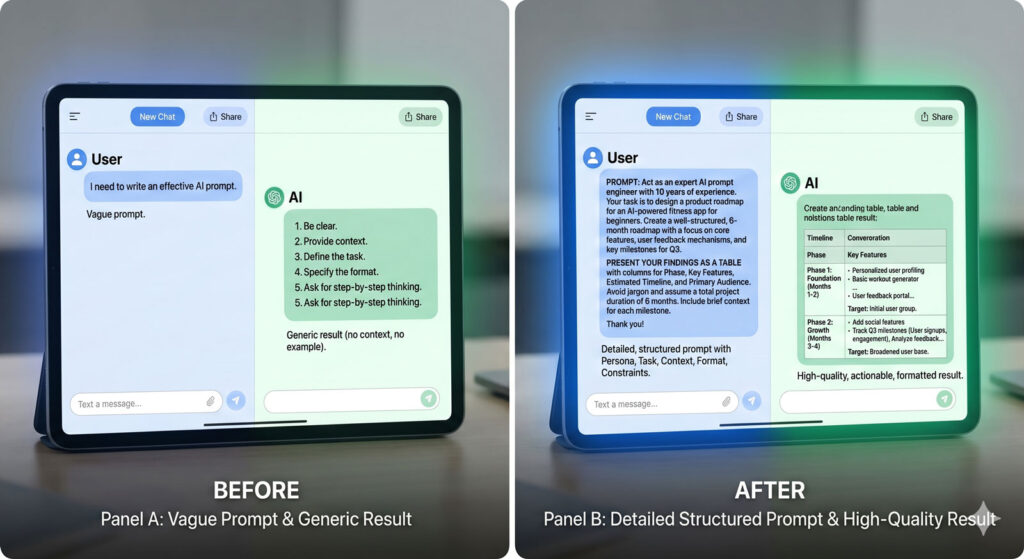
The difference matters more than most people realize. A vague prompt produces average output. A well-structured prompt produces output that often feels like it was written by a specialist.
And in 2026, with AI embedded in everything from content workflows to customer service to legal research, the gap between someone who prompts well and someone who doesn’t is a genuine professional advantage.
Why Prompt Engineering Became Its Own Discipline
When ChatGPT launched in late 2022, people quickly noticed something strange: the same AI model produced wildly different results depending on how you asked. One person got a generic five-paragraph essay. Another person got a deeply nuanced analysis — from the same underlying model, on the same topic.
The difference? How they asked.
This spawned an entire field. By 2023, companies were hiring “Prompt Engineers” at salaries north of $200,000. That gold rush has settled down, but the underlying skill hasn’t lost its value. It’s just become table stakes for serious AI users.
Every marketer, writer, developer, and business owner who works with AI tools regularly is now, to some degree, doing prompt engineering. The question is whether they’re doing it intentionally or just fumbling through it.
The Core Components of a Good Prompt
Good prompts aren’t magic spells. They’re structured. Here’s what goes into one:
1. Role or Persona
Telling the AI who it is changes how it responds. “Write a blog post about caffeine” produces something generic. “You are a sports nutritionist writing for competitive runners. Write a blog post about caffeine timing for marathon prep” produces something specific, authoritative, and useful.
2. Context and Background
AI doesn’t know your audience, your brand voice, your product, or your constraints unless you tell it. That context matters enormously.
A prompt with zero context: “Write a product description for our software.”
A prompt with context: “Write a product description for Streamline, a project management tool built for remote marketing teams of 5–20 people. The tone should be confident but not corporate. The description should be under 150 words and lead with the key benefit: saving 3 hours per week on status updates.”
3. Task and Output Format
Be explicit about what you want. Not just the topic — the format, the length, the structure, the audience. “Write a comparison table” gets you a table. “Write a few thoughts” gives you a vague paragraph. Be literal.
4. Constraints and Exclusions
Tell the AI what NOT to do. This sounds counterintuitive, but it’s one of the most effective prompt techniques out there. “Do not use bullet points. Avoid academic language. Don’t mention competitor products.” Constraints make outputs dramatically more consistent.
5. Examples (Few-Shot Prompting)
If you want a specific style or format, show the AI an example. This is called few-shot prompting — giving the model 1–3 examples of what good output looks like before asking it to produce its own. This technique alone can cut your editing time in half for repetitive content tasks.
A Real Prompt Example — Before and After
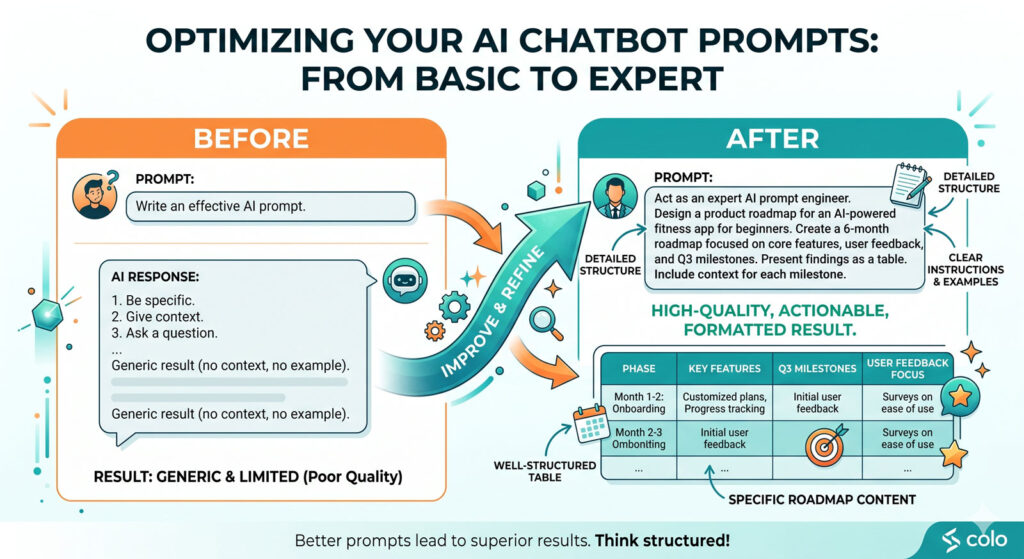
Before (Zero-Shot, Unstructured)
“Write me a LinkedIn post about AI tools for marketers.”
What you get: A generic 150-word post with buzzwords, three hashtags, and a call to action you’ve seen 400 times.
After (Engineered Prompt)
“You are a digital marketing strategist writing for a LinkedIn audience of mid-level marketing managers at B2B SaaS companies. Write a LinkedIn post about how AI tools are changing content strategy in 2026. The post should be 120–150 words, use a first-person voice, lead with a specific observation rather than a question, avoid clichés like ‘game-changing’ or ‘revolutionizing,’ and end with one concrete action the reader can take today. No hashtags.”
What you get: A post that actually sounds like a human wrote it, with a specific hook, a clear point of view, and a practical takeaway.
Types of Prompt Engineering Techniques
| Technique | What It Does | Best Used For |
|---|---|---|
| Zero-Shot | Single prompt, no examples | Simple tasks with clear instructions |
| Few-Shot | Include 1–3 examples in the prompt | Style-matching, format replication |
| Chain-of-Thought | Ask the AI to reason step-by-step | Complex reasoning, analysis |
| Role Prompting | Assign a persona or expert identity | Specialized knowledge tasks |
| Prompt Chaining | Break tasks into sequential prompts | Long-form content, research workflows |
| Self-Critique | Ask AI to evaluate its own output | Quality improvement, editing tasks |
Common Prompt Engineering Mistakes
- Being too vague: “Write something engaging” gives the AI nothing to work with.
- Overloading one prompt: Asking the AI to research, write, edit, and format in a single prompt usually produces mediocre output across the board.
- Not iterating: Your first prompt is a draft, not a final request.
- Ignoring the system prompt: If you’re using the API or tools that support system prompts, use them.
- Accepting the first output: Even great prompts produce imperfect first outputs. Always review, always refine.
Prompt Engineering in 2026: What’s Changed
Models are smarter but still need guidance. GPT-4o, Claude 3.5, Gemini 1.5 Pro — all of them are dramatically more capable than models from two years ago. But they still respond to prompt structure. The fundamentals haven’t changed; the ceiling on what good prompting can achieve has just risen.
Multimodal prompting is now the real thing. You can prompt with images, PDFs, audio transcripts, and structured data. The same principles apply — context, clarity, format instructions — just extended to non-text inputs.
How to Start Practicing Prompt Engineering Today
- Pick one repetitive AI task you already do — like writing email replies, summarizing documents, generating social captions.
- Write down your current prompt exactly as you use it.
- Add role, context, format instruction, and at least one constraint.
- Run both prompts side-by-side on the same task.
- Note specifically what changed and why.
- Iterate. Change one variable at a time.
🎯 Key Takeaways
- Prompt engineering is about structured, intentional communication with AI
- The core components: role, context, task, format, constraints, examples
- Few-shot prompting and chain-of-thought are the two highest-leverage techniques
- Common mistakes: vagueness, overloading, not iterating
- You can start right now with any task you already use AI for
- In 2026, this skill is table stakes for anyone working with AI regularly
Final Thoughts
Prompt engineering isn’t a superpower reserved for developers or AI researchers. It’s a communication skill. And like all communication skills, it gets better with deliberate practice.
I’ve seen non-technical marketers produce better AI output than engineers, purely because they were more thoughtful about how they structured their requests. The tool matters less than how you use it.
Start with one prompt. Make it better. Notice what changes. That’s the whole discipline in miniature.
Want to go deeper? Check out our guide on advanced prompt techniques or try our prompt template library for common marketing and content tasks.